
Question your model in plain English and get an answer back in seconds, fully cited.
For example: Summarize how revenue is built up and which drivers move it most. Where does EBITDA land this year if the pipeline holds? Compare all scenarios side-by-side. What drives the differences? Reverse-solve: what would have to change to break even a quarter earlier?
An accounting agent for your finance team
It takes on the repetitive half of the close. Bank, card, payroll and billing come in, and every entry arrives proposed with its reasoning attached. Your accountants review it and post it to the accounting system you already use, so the books close faster and their hours go to the judgment calls.
A built-in intelligence layer
Run your sensitivities and scenarios against the live actuals, and ask the model anything in plain English.
Defensible all the way down
Every figure traces to the page it came from, and to the formulas that depend on it. Download it and the workbook is real, working Excel, so your board, your lender and your auditor follow the arithmetic themselves.
Collaboration enabled
Unlock anyone on the team to ask questions and get cited answers in seconds, so your business moves forward even if the one who built your model is on a plane.
Validation on every build
Nothing reaches your board unchecked.
Every build runs hundreds of deterministic checks against the model: balance sheet integrity, cash flow mechanics, sign conventions, assumptions that have quietly gone dead. Each one either passes or fails, so trust rests on something you can point at. A broken relationship surfaces while it is still cheap to fix, well before the meeting.
See how the validators workChecking now
Validator categories include Balance sheet balance, Cash flow mechanics, Revenue reconciliation, Sign conventions, Circular dependencies, Asset rollforward, Depreciation rates, Scenario differentiation, Assumption reasonableness, Natural units, Dead assumptions, Degenerate growth rates, Churn methodology, Source provenance.
Each check gives the model a clear failure to fix, rather than asking your team to find it by eye.
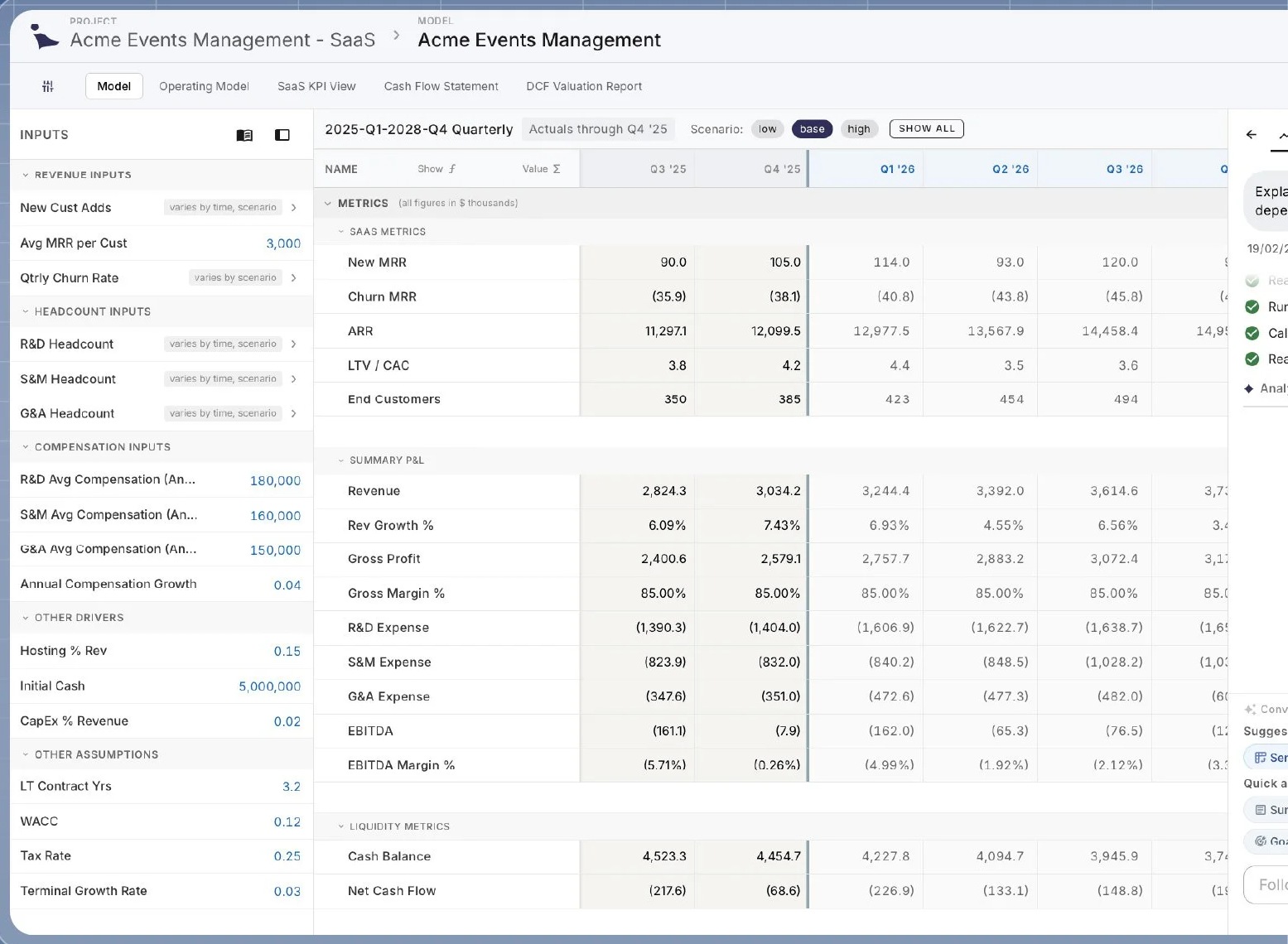
The whole model, built on your numbers
Drivers, headcount, churn, scenarios and all three statements, stood up from your own historicals and shaped by how your business actually works. Change one assumption and see the impact immediately.
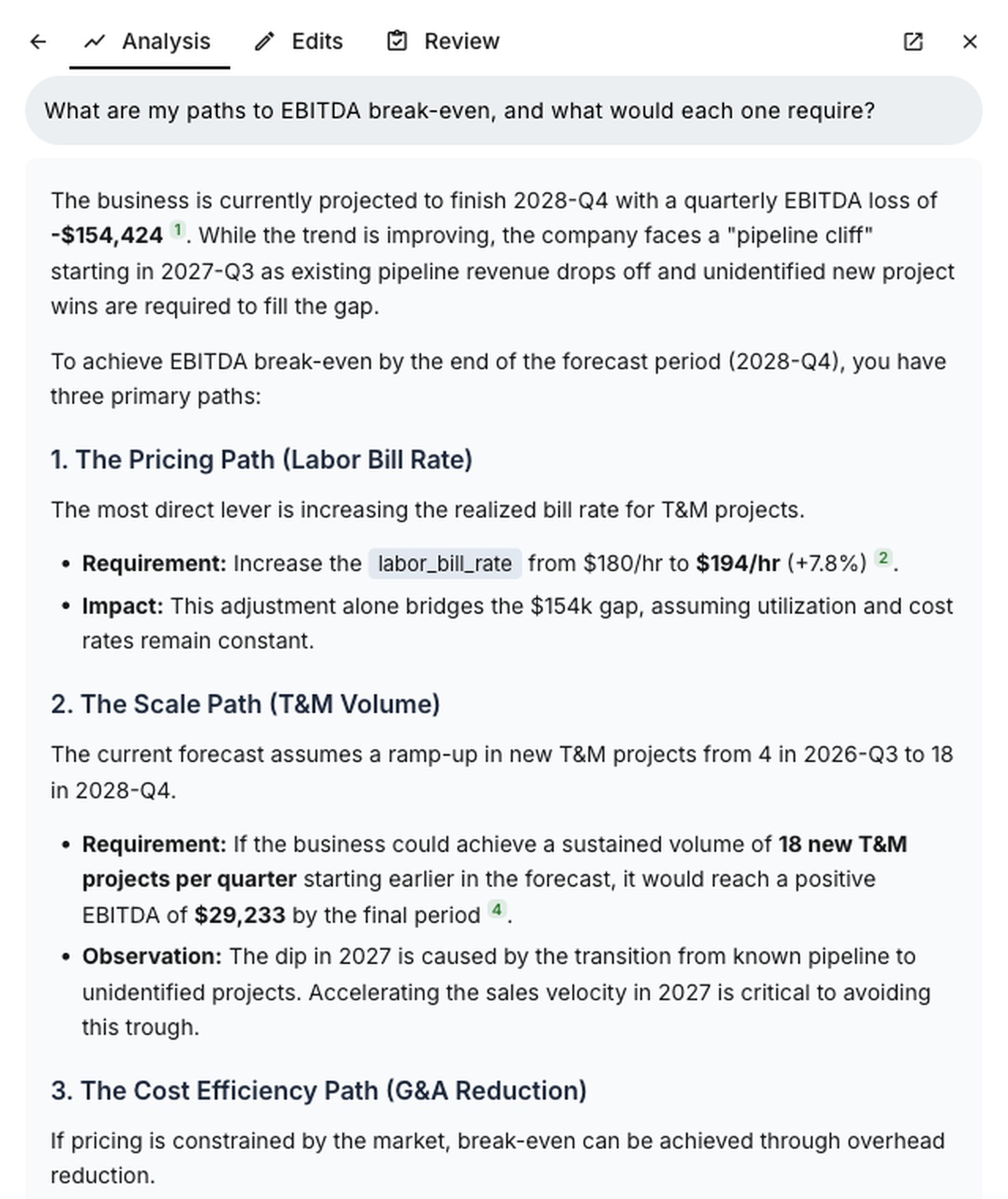
Your analyst, always on
AI Analysis provides practical, data-grounded responses that help you make the best decisions for your company.
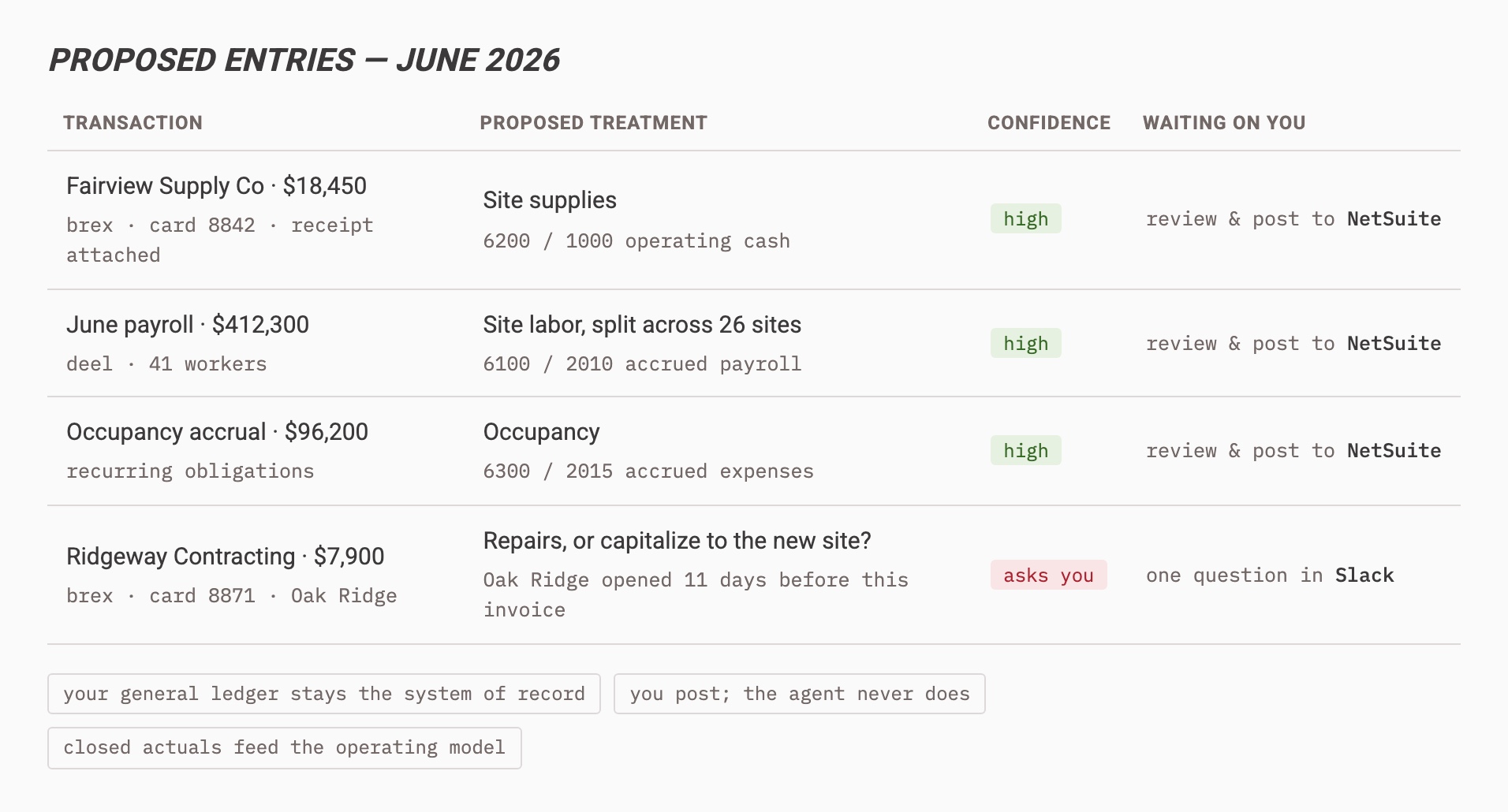
An agent beside your ERP
Your general ledger stays where it is, and so does the posting. The agent does the repetitive part of the close around it: pulling sources, drafting each entry with the reasoning attached, allocating payroll, reconciling cash, and handing you proposals to review. You post. Because it also knows the drivers behind your numbers, what it proposes reflects how the business actually works.
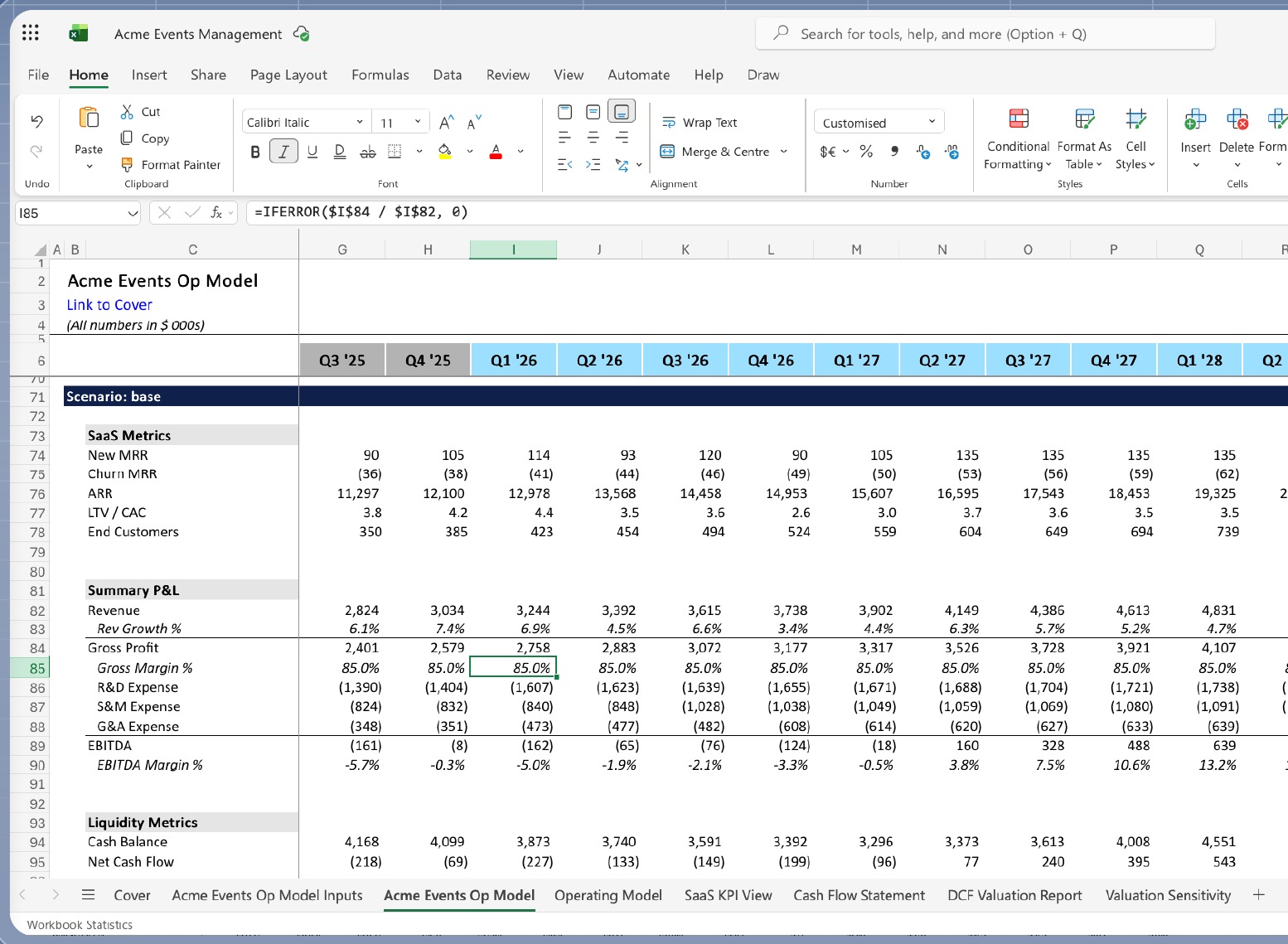
Excel underneath it all
Your work stays in the model, where every number is live. Underneath it the arithmetic is genuine Excel formulas, so the moment your board, your lender or your auditor wants to check it, hand them the workbook and they follow the same math in a file they already know.
Built to a CFO’s standard. Usable by anyone.
Whether you have a finance team or you are the finance team, your model grows with your business.
Finance Teams
The model your month runs on.
Build the operating model for the company you actually run, then let the close keep it honest. Actuals land, closed months lock, and the board pack falls out of the same source.
Learn moreDeal Teams
A first-pass model the day the target lands.
Screen a target on your own assumption framework, then keep the same model through diligence, IC and the quarters after you own it.
Learn moreSee it on your own numbers
Bring a P&L export and a pipeline sheet. In 10 minutes you will see the model underneath your own business: where the year lands, and the workbook you can hand to your board.
Want to see the checks behind it? Read how we validate a financial model, including the reference workbook, its inputs, and the hundreds of checks that run on every build.