
Every workflow, one model
Planning, pipeline, schedules and variance for the business you run, plus the diligence work for the ones you underwrite. All of it on the same model, so nothing has to be kept in step by hand.
Planning & Forecasting
The plan for the business you run
Build a driver-based operating model on your own historicals, then re-forecast against it every month without starting the workbook over.
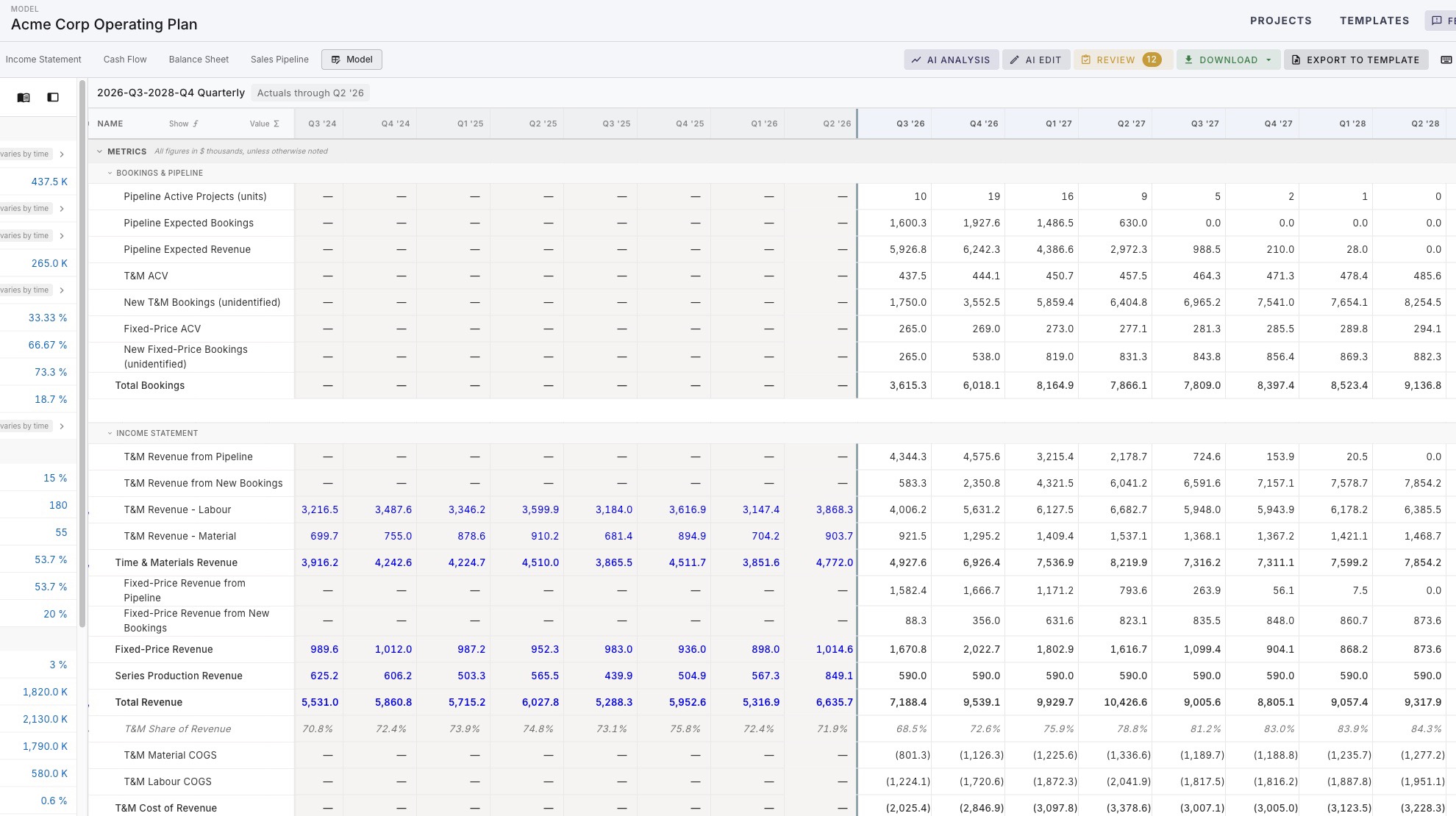
A model built from drivers, not cells
- Headcount, pricing, volume, and cost drivers as named assumptions
- Scenarios and sensitivities side by side on one model
- Income statement, cash flow, and balance sheet from the same source
- Export to a live formula workbook your board and lender can open
Re-forecast without rebuilding
- Closed months lock automatically as each month ends
- Restatements and new periods detected, not manually patched
- Ask any figure why it moved and get a cited answer
- Version history shows how the plan actually changed
Test the decision before you make it
- Scenarios side by side, rather than four forks of the same workbook
- Price a hire, a capex program, an add-on or a raise against the plan
- Sensitivities across every operating lever at once
- See what is trending off-plan before it turns up in the board pack
Sales Pipeline
Pipeline that lands in the revenue line
Your CRM export becomes a deterministic schedule: weighted deal by deal, spread by expected close month, and wired straight into the forecast.
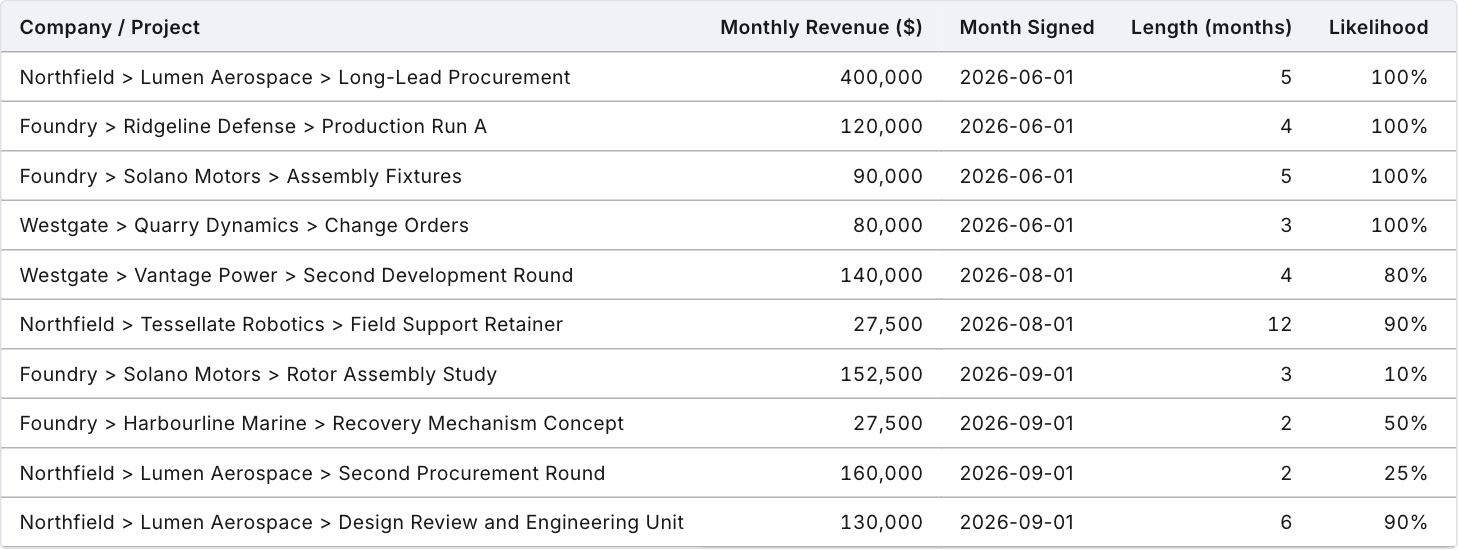
Every weight and date is yours to set
- Stage weights are editable assumptions, not buried constants
- An explicit close-date rule ladder with an audit column per deal
- Deals with no date signal surfaced and excluded, never dropped
- Weighted and unweighted views by close month, side by side
Wired into the model
- Expected value computed as a formula on every deal row
- Pipeline rollups feed bookings, revenue, and cash
- Change a weight or a close date and the forecast updates
- Closed-won cross-checked against what the books actually recorded
Accounting & Close
Beside the ERP you already trust
Your general ledger stays exactly where it is, and so does the posting. An agent does the repetitive part of the close around it: pulling the sources and proposing each entry with the reasoning attached, so what reaches you is a decision to make rather than a form to fill in.
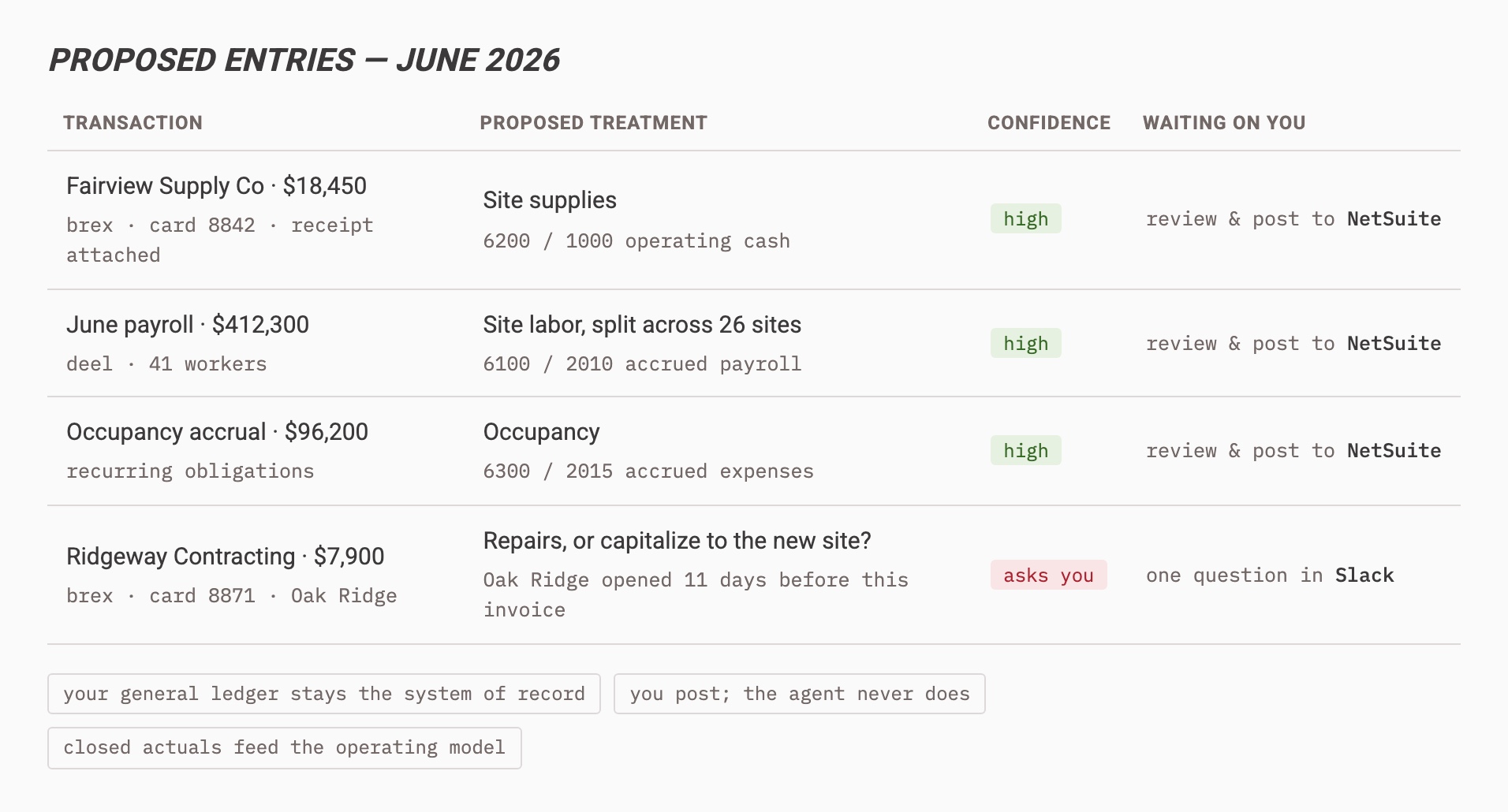
Take the manual work out of the close
- Bank, card, payroll and billing pulled in on a schedule
- Entries proposed and categorized against rules your team can edit
- Accruals, departmental allocation, and cash reconciled to the statement
- Entries prepared for posting into QuickBooks, NetSuite or Sage Intacct
It knows the business, not just the transactions
- Proposals informed by the drivers behind your numbers and your own history
- An ambiguous transaction arrives as one focused question in Slack
- Your answer settles the entry and is kept as a rule for next month
- Closed actuals feed the operating model, if you run the forecast too
Actuals & Variance
Every cycle, on rails
Budget-vs-actual, month-over-month flux, roll-forward, and the reporting pack, generated from the latest version of the model rather than reassembled by hand.
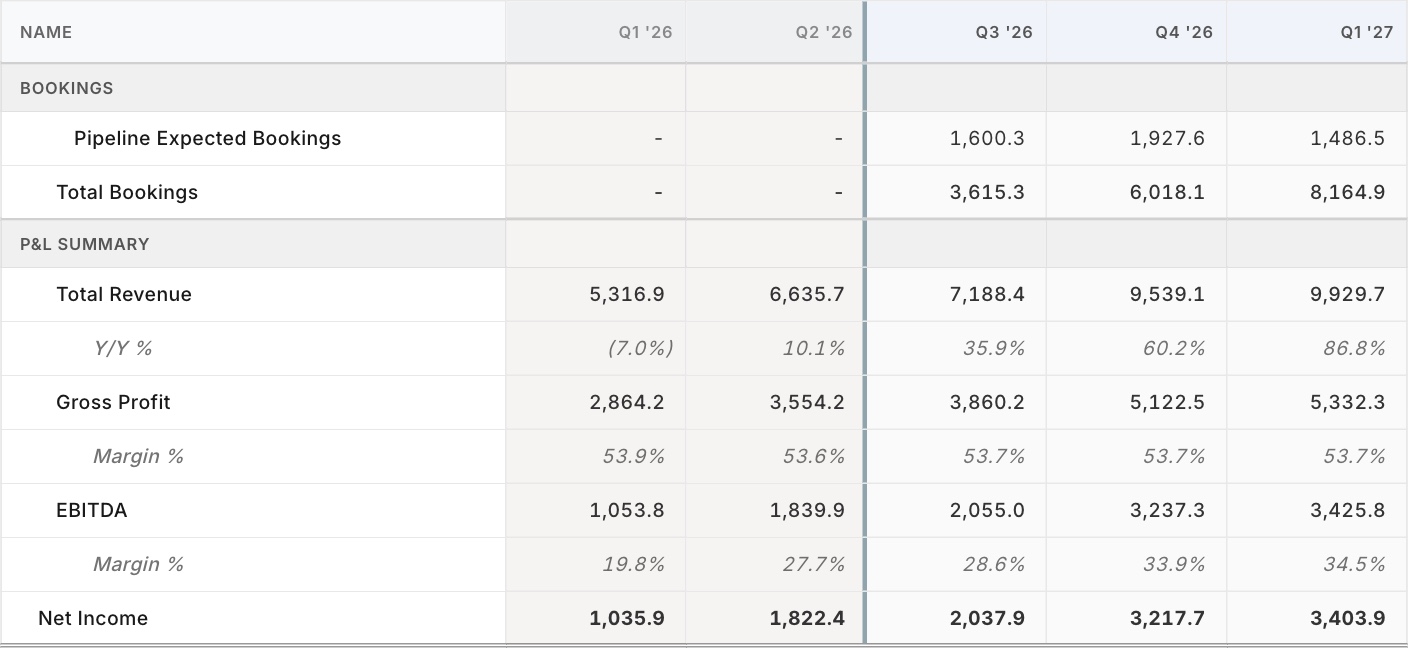
Close the loop each period
- Compare the ledger to the model’s own forecast, per scenario
- Variance signed so favorable and unfavorable read correctly
- Month-over-month flux explained at the account level
- Closed-month actuals verified against the books to the cent
Reports your board and auditor can follow
- Board and QBR outputs pulled directly from the model
- ASC 820 fair value workflows with cell-level traceability
- Narrative tied to live model values, not retyped from a deck
- An auditable trail that carries across reporting cycles
Calculated Schedules
Site-level math, generated and maintained
Site-level P&L, depreciation schedules, customer rolls, revenue recognition, and cash collection, generated as auditable sub-models that flow up to the consolidated forecast.
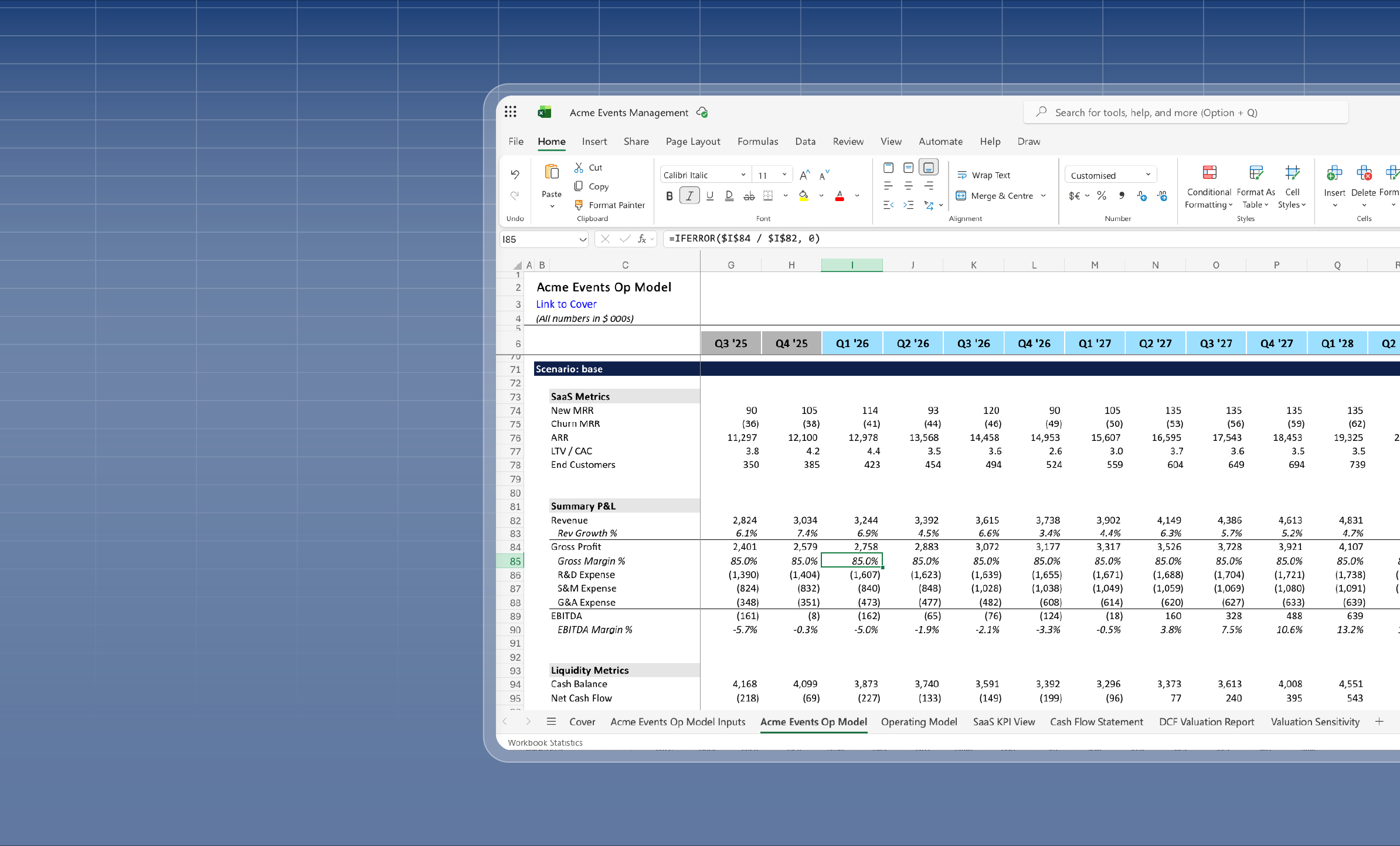
Operational schedules at scale
- Site-level P&L roll-ups across hundreds of locations
- Depreciation schedules with asset-level traceability
- Customer rolls with cohort retention and revenue recognition
- Cash collection timing tied to invoice and payment patterns
Forecasting that ties out
- Schedule outputs flow up to the consolidated forecast
- Single source of truth for reporting and projection
- Reconcile actuals against schedule-level assumptions
- Re-cast schedules without rebuilding the full model
Existing Workbooks
Start from the workbook you already have
Nobody rebuilds a model that already works. Bring the one your team already trusts and it comes back doing everything on this page, with your formulas and your structure intact.
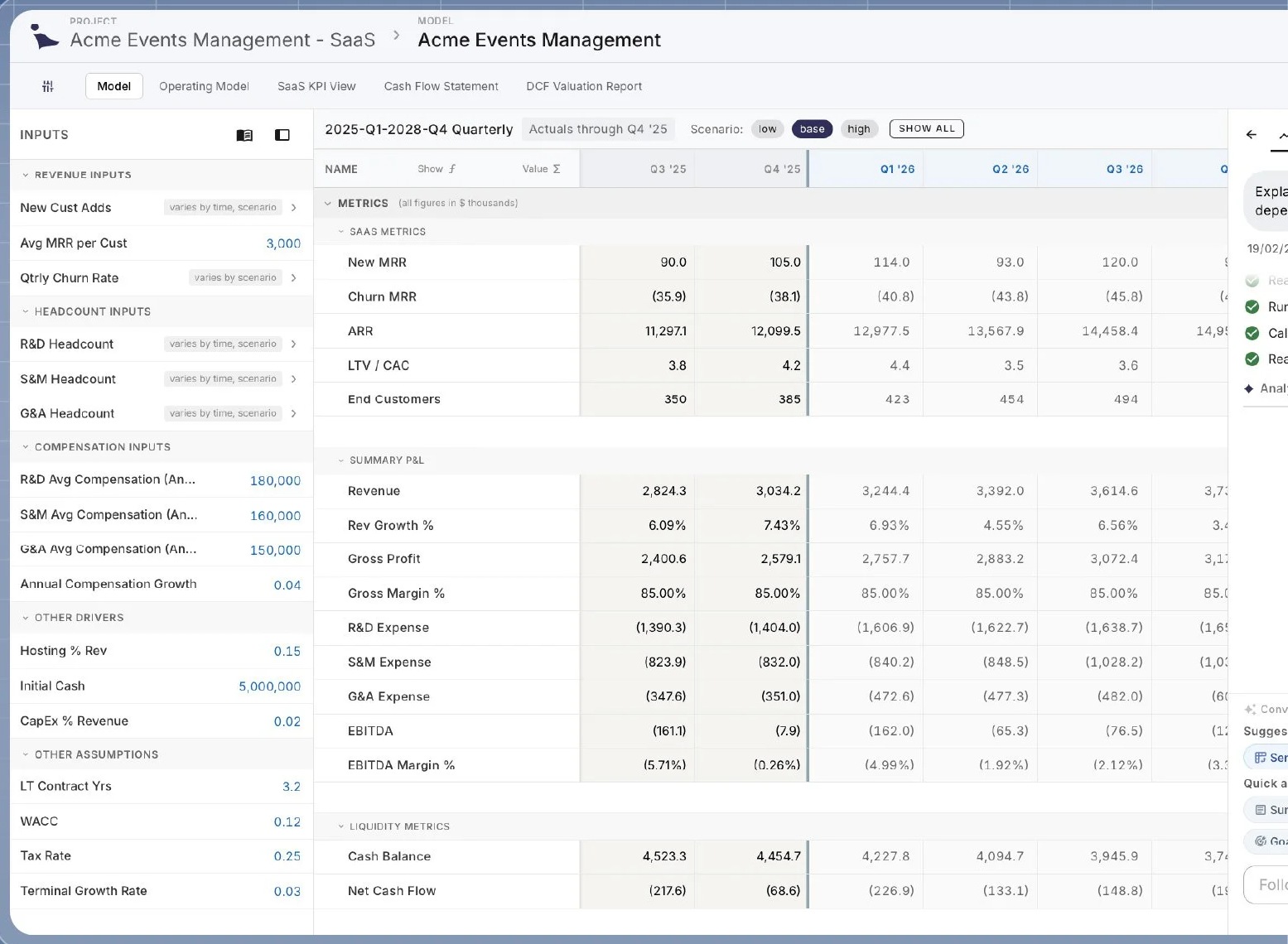
Your formulas, kept
- It stops being a file only one person can open and run
- Native Excel formulas preserved and still calculating
- Every change lands as a cell-level diff you can audit
- Export back to a live formula workbook whenever you want it
Then ask it anything
- Drill into any number with conversational follow-up
- Surface anomalies, broken links and assumption drift
- Add scenarios, sensitivities or new schedules
- Compare versions of the same model over time
Deal Evaluation
Advance the right deals, faster
Rapidly evaluate opportunities with portfolio-consistent assumptions. Compare structures and bids. Focus diligence where it matters most.
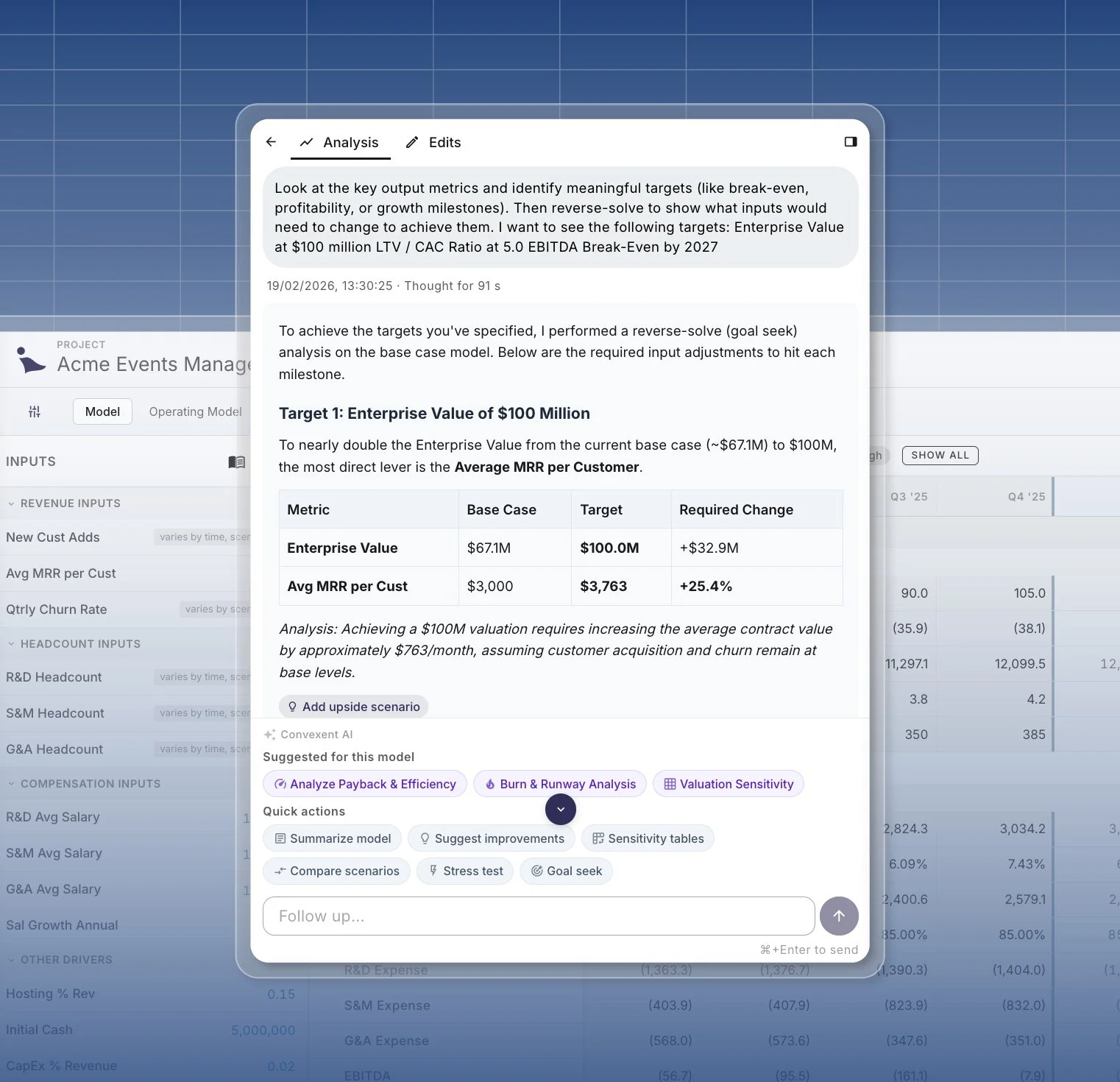
From CIM to model in minutes
- Build base models from CIMs in minutes
- Apply portfolio-wide assumption frameworks consistently
- Surface key risks and value drivers early
- Stress-test projections through sensitivity analysis
Compare bids and structures with conviction
- Compare scenarios across bids and structures
- Drill from any IC number to the underlying drivers
- Eliminate one-off models and version sprawl
- Expand deal coverage without rebuilding models